
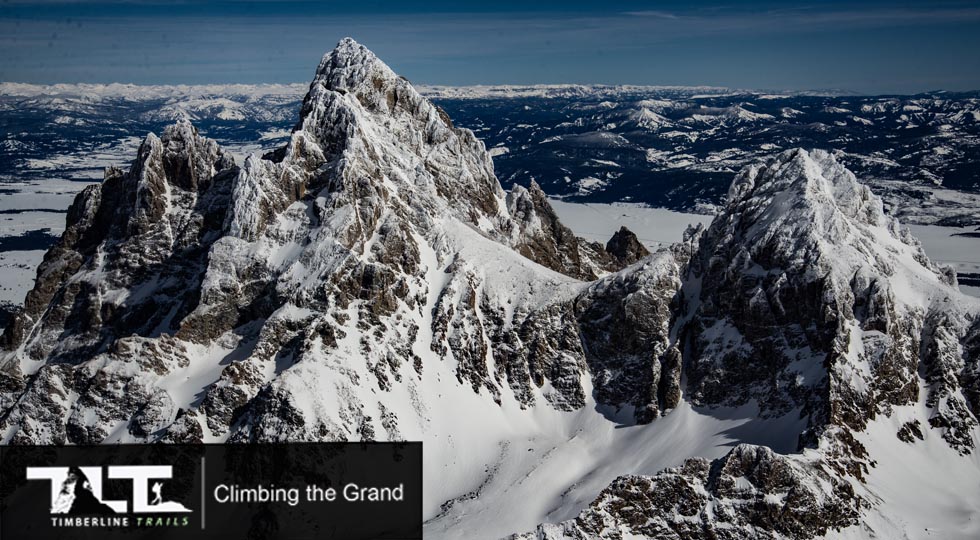
The Owen-Spalding route is named after the climbers who made the first claimed ascent: William Owen, Franklin Spalding, Frank Peterson and John Shive. There is some debate as to which person made the first ascent; however most agree this group was the first. Both routes begin at the Upper Saddle which is reached by hiking from Lupine Meadows Trailhead, up Garnet Canyon, to the Lower Saddle. The route we choose, and which is shown here, is the Owen-Spalding route. Permits are required for all overnight stays.
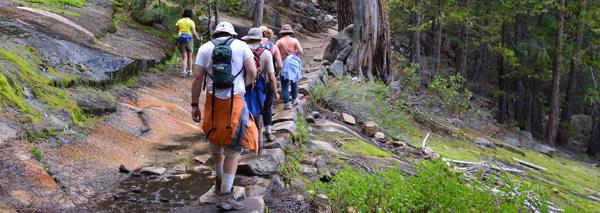
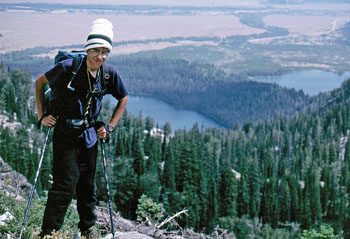 In the photo you can see the hiker a couple of miles into the hike with beautiful Taggart and Bradley lakes along with a view of the little town of Moose below.
The Garnet Canyon trail begins at the Lupine Meadow Trailhead just south of Jenny Lake at the end of a short dirt road off the main park road. There is a fair amount of parking available, but it is quickly filled up due to the popularity of the area, and it is best advised to get there early.
The trail most often used for access for climbing not only the Grand Teton but also for climbing the South and Middle Teton along with Disappointment Peak and Teepe Pillar.
In the photo you can see the hiker a couple of miles into the hike with beautiful Taggart and Bradley lakes along with a view of the little town of Moose below.
The Garnet Canyon trail begins at the Lupine Meadow Trailhead just south of Jenny Lake at the end of a short dirt road off the main park road. There is a fair amount of parking available, but it is quickly filled up due to the popularity of the area, and it is best advised to get there early.
The trail most often used for access for climbing not only the Grand Teton but also for climbing the South and Middle Teton along with Disappointment Peak and Teepe Pillar. 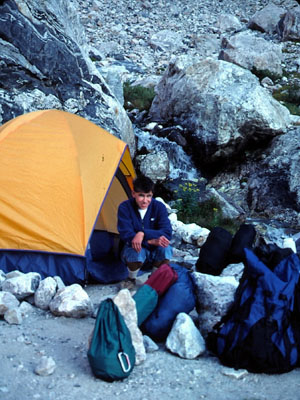 Garnet Canyon Trail is well maintained and passes through many beautiful sections of the mountain and eventually bumps up against a boulder field at the 9,500 foot elevation level and this marks the end of the maintained trail. Getting through the boulders will involve a fair amount of effort, but will eventually give way to easier ground. The trail is 4.2 miles to the boulder field one way, and you will have gained 2,650 feet of elevation for your efforts.
After getting through the granite rock boulder field, you will be able to get a clear view of Middle Teton (also a worthwhile climb).
We set up camp in Garnet Canyon Meadow in order to hang out until we were allowed into the lower saddle. Permits are issued on the bases of where you intend to camp when climbing the Grand. This is designed so that too many people will not crowd into any one location along the route.
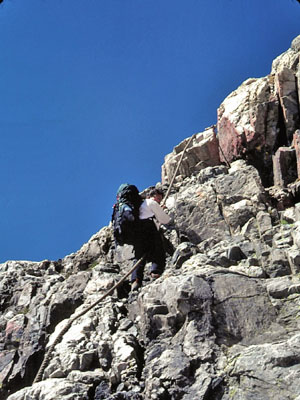 After breaking camp, it a fairly short bit of distance on the unmaintained trail, we came to the Teton head wall. Here, you will find a very thick fixed rope, which proves to be very handy when carrying a pack up some of the steep boulders that eventually gives way to access to the lower saddle where most parties camp for their attempt on climbing the Grand Teton.
In the photo, you can see Mike making use of the rope to aid him up this section.
The lower Saddle is at 11,600 feet and the altitude gain from the Lupine Meadows Trailhead to the lower saddle is 5,000 feet! After gaining the lower saddle, you still have approximately 1,550 feet to go of the most challenging terrain of the climb.
Some of the other noteworthy peaks in the area, are South Teton 12,514 feet, Teewinot Mountain 12,325 feet, and Teepee Pillar 12,166 Feet.
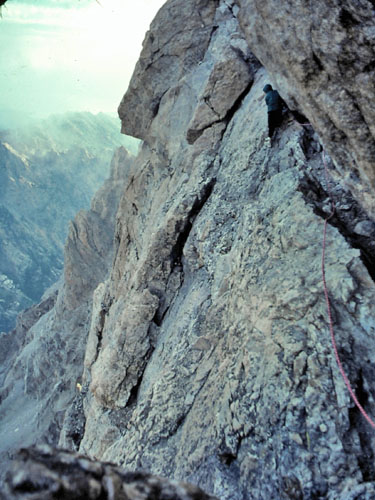 From the lower saddle, you have a bit of a scramble to the upper saddle. This is where the Owen Spalding Route begins, but you also have a few other routes such as the Exum Ridge which is also very popular and many people will choose that option. Wall Street marks the beginning of that Route.
In the accompaning photo, you can see Sean (as seen within the red circle), working along what most climbers would say is the most technical section of the Owen Spalding Route. It has been nicknamed "The Crawl" rated at 5.5
Rather than crawling in the tight area that you can see in the photo, we decided to do a mild layback position that we found to be less uncomfortable and quicker than crawling along this section. However, due to the exposure, many folks decide to crawl through this section. Certainly as with any area of the climb, a fall would not be nice here with 2,000 feet of clear air below you.
Once across "The Crawl" we found the rest of the way to the summit to be more of a scramble with plenty of good sized handholds and footholds.
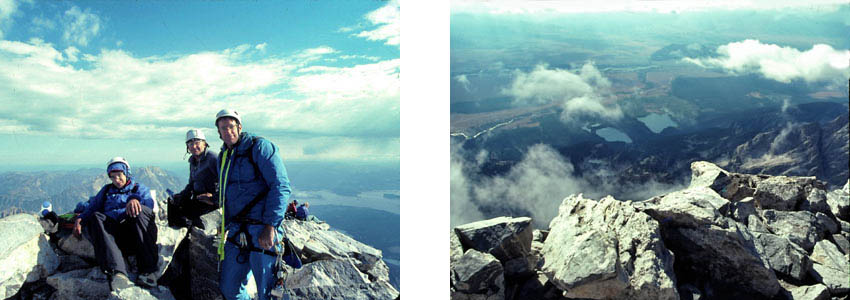 Finally, Sean, Mike, and I reach the summit. All in all, a great adventure and one that we will always remember. Climbing is great fun but comes along with lots of work. In the end, however, it is always worth the effort for the challenge and great views from the summit as you can see in the right hand photo.
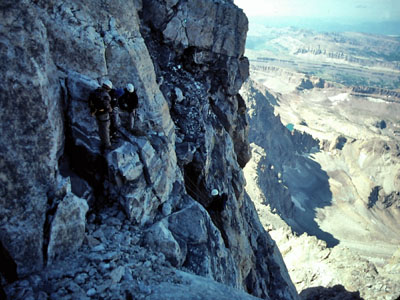 The last challenge is getting down. In the red circle in the photo, you can see climbers preparing for the longest rappel on the descent of the Grand Teton (about 140 feet in length). I found this rappel to be as challenging as any I have ever done, due to the fact that you seem to drift off course as you descend.
Descending is always a serious matter on any climb and the Jenny Lake Climbing Ranger Station has a plaque on the wall reminding climbers that about 80% of the accidents and deaths happen on the decent, not on the assent. This fact is attributed to the fact that you are fatigued at that point, and momentum down is far greater and less visible than on the way up. That being said, caution is the guide word.
Well, that's about it for our climb up the Grand Teton. Hope that all you climbers out there get a chance, if you have not already made the climb, to make this classic climb. It is well worth it to be sure!
Email Sign Up
| Join the Adventure! Sign up here for Timberline Trails Monthly Newsletter |

Join us on Instagram

©2006-2026 TimberlineTrails. All Rights Reserved.
....